22 July 2011

Nails not construction style

I read 

That Madame Magasine is having a manicure!
Wow!
with in style nail polish ...


... therefore, I think!

OK humor me and do the following:
Left hand ... LOOK AT YOU NAILS.


Now, tell me how did you look at them?

A while back, I had read an article talking about the difference on how men and women were looking at their nails ... different perspective ...  have tried to find back that article on the internet and have only found reference to it on Crossdressers website, so I gave finding it, you will have to believe me.

SO, what is your answer?

Option 1


Apparently that would be the way women look at their hands (nails)

Option 2

Colour I've picked: N.Y.C. Canal street

... and that would be the way men are looking at theirs.


It may just be an urban myth, but whenever I have done the test ... it never fails.
However, as in every rule there are exceptions ... and I had the idea on doing today's topic when I saw JJP's picture on Madame Magasine ... and my exceptional friend just made an exception to this "myth/rule" ...

Here is her picture ...
Colour: Lise Watier - Urban Taupe

Just for fun, try it with your friends and let me know your results.

20 July 2011

The Doors ... of Bern!


I read

Archaeologists in the Swiss city of Zurich have unearthed a 5,000-year-old door that may be one of the oldest ever found in Europe.

The ancient poplar wood door is "solid and elegant" with well-preserved hinges and a "remarkable" design for holding the boards together, chief archaeologist Niels Bleicher said
- The Guardian 20 October 2010

... therefore, I think!


You will remember that when I was visiting Yale, I had fallen in love with the doors ... since then, I do not look at doors the same way. On my trip to Bern, Switzerland I had the pleasure to photograph several really nice ones. 

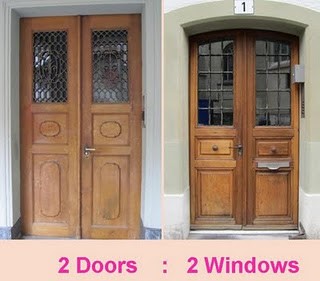
The one on the right top corner, reminded me a bit of the Elizabeth Arden Red Door or even Talbot's ... I do not specially like shopping, but I like spending ! The bottom right one is very interesting because it looks like nothing but in fact this door gives on the street ... during business hours it is opened and leads to a downstairs store ! very clever. This one was my favorite of this style. 


The other two are from 2 different houses.

These doors are all of different usage (not only used as front door for a house). 
Picture on the right top: a house (wooden door) and bottom: garage door of a private house.


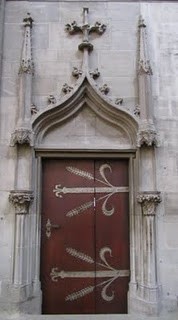
The top and bottom left corners door are at the Nydeggkirche church. The original small church was built from 1341 to 1346 to replace the old fortress. This early church featured a roof turret. From 1480 to 1483 the city added a tower and from 1493 to 1504, a new nave was added. After the Protestant Reformation in 1529, the Nydeggkirche was transformed into a warehouse for barrels, timber and grain, but in 1566 again served as worship space, and until 1721 it was a branch church of the Münster of Bern.

In 1863, the church was extended to the west and an entrance from the Nydeggbrücke (Nydegg Bridge) was added. Then, from 1951 to 1953 a total renovation happened. During the renovation, bronze reliefs by Marcel Perincioli were added to the main entrance at Nydegghöfli and the entrance to the bridge.

No windows, but if you look carefully you will notice that all of them have a peephole to see who is at the door. I like them all but my favorites are the ones on the far right (top and bottom)

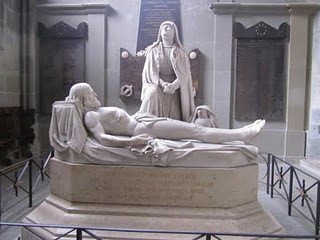
I absolutely love the right top shelf door. This door was inside the Cathedral - Münster of Bern which by the way is splendid! Look at theses!


If you look at the right picture Nice window), you will see 3 of them on the left picture, way way in the back above the doors.
Can you imagine me on my knees in front of a lying man?
Being enlighten !! 
tsk tsk tsk ... I've just read your mind !
... but I love this picture with the light coming down on them

OK, let's continue our doors' journey ...
Front door of different houses, nice hey?


 ... and to complete the series ... 2-door doors ...


... and major entrances of different government offices.


Don't you think it is interesting to think of the personality of the owners when we look at one of these doors?
It is unfortunate that in America, we have lost the usage of wooden doors, carved, and all ... love it!

18 July 2011

Nutella loaf

I had breakfast 

in Europe ... with Nutella


... therefore, I think!

That I can share with you another great recipe I made and that reminds me of breakfast in Switzerland, Germany or France. Europeans seem to fuel on Nutella in the morning !

Nutella was first created in the 1940s by Mr Pietro Ferrero, a patisserie maker and founder of the Ferrero company. Second World War rationing meant that cocoa beans were in short supply. To extend the chocolate ratios, Mr Ferrero mixed toasted hazelnuts with cocoa, cocoa butter and vegetable oil to create 'Pasta Gianduja', which was originally sold in loaves.


In 1949 Ferrero altered the original recipe so it could easily be spread onto bread and was then known as 'Supercrema Gianduja'. In 1964, reflecting one of the main ingredients, it was renamed nutella. 

Nutella Loaf
Prep: 30 min + 2 hours rising     Cooking time: 25 min     Serves: 12

Ingredients
  • 7g dried yeast
  • 5 ml sugar
  • 250 ml warm milk
  • 400g plain flour
  • 5 ml salt
  • 1 egg, lightly beaten
  • 30 g butter, melted and cooled slightly
  • 15 ml milk (extra)
  • Nutella, enough to spread


Preparation
Grease a baking tray.

Mix the yeast, sugar and warm milk in a bread machine. Start the Dough program and close the cover for 10 min.

Mix the flour and salt in a bowl. Add to cover the yeast mixture. Make a well in the center and add the egg. When the kneading process is completed, put the dough in an oiled bowl, cover loosely with greased plastic wrap and leave in a warm place for 75 min, or until doubled in size.

Punch down the dough, turn out into a floured surface and knead for 30 second, or until smooth. Roll out to a rectangle, 30 x 20 cm, and brush with some extra milk. Spread the Nutella. leaving a border. Roll lengthways into a log shape.

Lay on the baking tray and brush with the remaining milk. using a sharp knife, slash the loaf diagonally at intervals. Leave to rise in a warm place for 30 min (cover with a damp tea towel).  Preheat the oven to 425F. Bake the loaf for 25 min, or until golden.

Source: Inspired by Soups and Breads, Step-by-Step Cookbook

17 July 2011

Bicycling to a date


I read

La bicyclette a contribué à renforcer la diversité génétique chez les travailleurs ruraux, en triplant leur rayon d'action en matière de recherche de partenaires durant leur jour de repos hebdomadaire. Ceci fut un facteur de réduction de la consanguinité en milieu rural.

I translate:
The bicycle has helped to strengthen the genetic diversity among rural workers, triplingtheir range in search of partners during their weekly day of rest. This was a factor in reducing inbreeding in rural areas.

... therefore I think!

Quebecers are almost all cousins, but most of them do not even know it. They will have to do an extensive genealogical research to find the ancestor they have in common. Often they will find a very distant ancestor, one which could cause very little risk to the offspring of two "pure laine" Quebecers (Quebec-born) who would have fallen in love.

Until recently, 95% of all people from Québec had at least one common ancestor. This was mainly true in the region of Charlevoix, Saguenay and Iles-de-la-Madeleine (Gaspésie). The French colonists who came New France (Canada) were mainly from Paris, Île-de-France and the French provinces of Aunis, Brittany, Normandy, Picardy, Poitou and Saintonge, while settlers of Acadia were populated mainly from the provinces of Anjou, Maine and Touraine. In addition, the "Filles du Roi" were from Ile-de-France, the provinces with the largest contribution to this movement were Normandy, Aunis, Poitou, Champagne, Picardy, Orléans, and Beauce. Only Alsace, Auvergne, Bourbonnais, Dauphine, Provence, Languedoc, Roussillon, Béarn, Gascony and the County of Foix seem not to have participated. Pleasance or the colony of Newfoundland were founded by the Basques in south-western France. Louisiana and North Bay were mainly populated by settlers already established in New France.

So I had to go back way back in time to continue ...
Close inbreeding has remained very rare in the Quebec of the past, even though husband and wife were often from the same parish.

In fact, marriage between cousins was discouraged and even forbidden by the Church. The Church was forbidding marriages for those spouses that were related. It must be said here that Quebec is/was predominantly Catholic and that all marriage licenses were registered and archived, only the priests could bless a marriage. However, it could happen that a couple requests a waiver to marry if the were related. With a monetary exemption, a couple could circumvent the ban (and I imagine be told that they would not have any problems with X chromosomes ...) All religious exemptions were recorded in the archives of the Archbishop of Quebec (and then transferred the civil archives).

No data were inventoried before 1885, until it became mandatory for clergy to report annual information to the bishop. We will remember that canon law requires an exemption for consanguineous marriages up to 6th degree inclusively. Before 1917, it was to the 8th generation.
So in conclusion, should we count our blessing in Quebec to not have more "defects"? ... and before you say anything ... I have to fess up ... my paternal grand-parents ... they were cousins -- first generation. So maybe to not have had children is a blessing in disguised for humanity! I am SO considerate!!!


13 July 2011

Alfalfa or Luzerne ?

I read

Alfalfa is a flowering plant in the pea family Fabaceae cultivated as an important forage crop in the US, Canada, Argentina, France, Australia, the Middle East, South Africa, and many other countries. It is known as lucerne in the UK, France, Australia, South Africa and New Zealand, and known as lucerne grass in south Asia. It superficially resembles clover, with clusters of small purple flowers.

... therefore, I think!

In Canada, in French it is also called LUZERNE ... like Luzern ou Lucerne ... it's all the the spelling and how it sounds ...

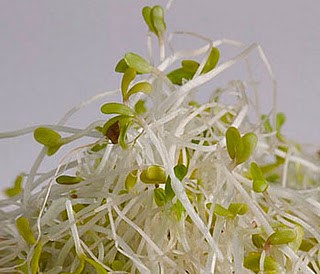
So, whenever I was thinking that I was driving to Luzern ... the only thing that was coming to mind was the little sprouts! Cracking up myself ! ha ha ha ... I am so funny. 

What I've discovered was very very nice!
Luzern is located in the German-speaking part of Switzerland, at the foot of the Swiss Alps (wow and rewow). I say it again, I love mountains.
So what did I see? A wonderful city !

I was lucky to find a parking space near by the old part of town. After a short walk, I was at the Main Railway Station which was totally rebuilt in 1984 and 1991 after a fire completely destroyed it. All that "survived" was the main portal.

From there I went toward the Lake to the Convention Center


I've continued my walk following the Reuss River.
Three things to note of the follow picture:

  1. The Watertower is an octogonal tower that was built around 1300. It is 43 meters high and over the years has been used as a prison, for archives, treasury and a torture chamber
  2. The Bridge: Kapellbrücke or Chapel Bridge: is one of the multiple wooden bridges of Switzerland. It is 204 meters long footbridge and was built in 1333. However, a smoker left a still lit cigarette in 1993 and the bridge and most paintings were destroyed but was quickly rebuilt ...
    The tower and the bridge are Lucerne's trademark and form the most photographed monument in the country.
  3. I have just talked about paintings ... well that covered bridge is home to more than 100 paintings dating from the 17th century and representing scenes of Switzerland and its history.
Lake Lucerne flows into the Reuss River, but how it the water level controlled?
Technically, this is a unique sight. The so-called "spikes" are lowered into or withdrawn from the water manually. It was built in 1859-60, replacing the Reuss steps that channelled the water over the city mills.

Two churches have attracted my attention.
The Jesuit Church was built in 1666 by Father Christoph Vogleer. It was the first large scle Baroque church to be built in Switzerland. Luzern is still mainly following the Roman Catholic Church.

The other one : the Hof Church is Lucerne's main church. It was built on a small hill east of the medieval downtown. It still somewhat dominates the scene of the city with its gothic twin towers. Hof Church belongs to a Benedictine monastery older than the city itself. A first church must have existed at this place as early as the 9th century, but only a few fragments of this period have remained. The gothic twin towers once belonged to a church that has been burnt down on Easter Sunday, 1633. Hof Church as it can be seen today has been built from 1633 to 1644 in Renaissance style with some Baroque elements.
Jesuit Church

Hof Church

The Musegg Wall, built between 1370 and 1442, is part of the historical city fortification that once had 30 towers. What remains of the wall today is 870 metres long, nine metres tall (on average) and 1.5 metres thick. 

There are now nine towers, four of which are open to the public during the summer months. Visitors can also walk along the top of the wall. From here there is an impressive view of the city, the lake and the Alpine panorama.
Musegg Wall


Panoramic view of Luzern.
Luzern from the main tower

... and lastly ... The Hotel Château Gütsch is located about 2,5km west of Luzern and is reached in a few minutes by funicular from Baselstrasse, or uphill on foot. It is on the edge of the Gütschwald and offers breathtaking views of the city, Lake Lucerne and the mountains. The landmark fairytale Château Gütsch dates from the mid-19th century and developed over the years from an initial simple inn to a luxury boutique hotel, restaurant and spa complex which is scheduled to re-open ... in 2012!

Château Gütsch

11 July 2011

Say Cheese


Still in my Cheese phase ...
what can i say Switzerland had that effect on me !!

Simple while so tasty.

Grilled cheese with Brie
Prep: 5min     Cooking time: 5 min     Serves: 2


Ingredients
4 slices of bread
90g Brie, sliced
butter

Preparation
Butter one side of each slice of bread.
Put cheese on 2 of them and cover with another slice.
Coot at medium heat in a anti-adhesive pan until golden on each side.

Reference: Ma Cabeza porque nothing else en el refrigerador when I came back from traveling.

10 July 2011

Holzbrücke Rapperswil-Hurden

I am 

We built to many walls and not enough bridges.
Isaac Newton

... therefore, I think!

Just when I thought that nothing could be made smaller than an IBIS bedroom, life's proved me wrong!

I was staying one night in Horgen, CH and upon recommendations, stayed at the Hotel Meierhof.

Here is a snapshot of my room:


Do not get me wrong this hotel was perfect! There are rooms that are bigger but I was there for one night after not having slept for 24 hours, I could have slept anywhere.

It is in the middle of the town, right across from the train station, has a great breakfast/drink lounge on the top floor with a superb view of the Lake Zurich. That was my first night stop after visiting Zurich and Rapperswill-Jona.
Holzbrücke Rapperswil-Hurden

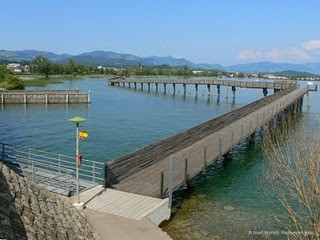
I had decided to swing by there to see the oldest wooden bridge in Switzerland. The prehistoric timber piles discovered to the west of the Seedamm date back to 1523 BC. The first wooden footbridge led across Lake Zürich, followed by several reconstructions at least until late 2nd century AD. when the Roman Empire built a 6 meters (20 ft.) wide wooden bridge. Between 1358 and 1360, Rudolf IV, Duke of Austria, built a 'new' wooden bridge across the lake that has been used to 1878 – measuring approximately 1,450 meters (4,760 ft.) in length and 4 meters (13 ft.) wide. On April 6, 2001, the reconstructed wooden footbridge was opened, being the longest wooden bridge in Switzerland.

While walking through town, I came by a restaurant that had the greatest idea I have ever seen to dine outdoors when it is raining. For people from Montreal, maybe we could use the idea for the Olympic Stadium ... just kidding! 

Look at that, it is a big plastic funnel! the borders are attached to the edge of the nearby walls that are enclosing the courtyard to go down to a manhole. I am not sure where the water goes (it could well reused to water the rose garden!) Anyway, I thought it was a good idea, you can even see the sky and when it is sunny, each table had a big sun umbrella.

This town was so tranquil, so serene. Maybe a 7-hour flight, followed by a fast visit in Zurich, when I've arrived there I was in need of some peaceful time. You can sit on benches near by the lake and just watch time passing by. Nothing moves too quickly.


Here are some of the roses from the rose garden:


08 July 2011

Zurich

I visited


SWITZERLAND


... therefore, I think!

My first stop in Switzerland was in Zurich.
My flight left Montreal at 5pm (GMT-2) ... arrived in Zurich at 6am (GMT+2) ... that will be a long day. If I want to be the jet-lag, I have to stay awake until at least 8pm!
As usual when visiting a new place, I have walked and walked and walked some more throughout town and took soooooooooo many pictures!

Sometimes, I wonder what we used to do when we did not have digital cameras. Maybe we were just enjoying more what we were seeing at the present moment, while now we try to capture as much as we can to look later ... anyway, I have tried to enjoy my trip as much as possible and bring back memories (for when I will be "parked" !)

Sometimes, streets just split ... you arrive at a point and the street you were on just disappear to make way to two new ones. Easy when you know where you are going, but if you have ever had to follow a tourist map to find your way ... you will remember that it happens that not all streets are on the map !
Anyway, I arrived at an interesting intersection: Newmarkt and Speigelgasse. After I found it, it was obvious when I wanted to go but the signs are in fact behind a big tree in from a restaurant full of tables, people, delivery trucks and more and more.
This van was also at the "corner" of the streets
I thought that the drawing was quite nice, until I arrived
closer and realized that it was in fact made with picture
similar to the ones we find on Facebook!
WOW!

Near by the lake I found a cute restaurant where all the chairs are different colors. It was so lively.
I have taken the picture of the river to show how clear the water is ! another wow!
Restaurant
SWISS CHUCHI

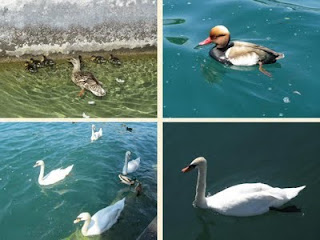
You talk about water, you almost cannot avoid birds.
In Rome you do like Romans. So around lunch time, I've stopped to one of the many stores, take-our restaurants and bought few things to go for lunch at the lake.

New Friends with whom I've shared part of my lunch.

Interestingly, while I was taking these pictures, my friend JJP was commenting her garden.
I know these pictures are not necessarily for a private garden, but I thought of sharing because there are some very interesting ideas that I may in fact try at home. We always see begonias in flower beds, but don't you think that the "begonia trees" are interesting? I can see that for someone who has a small yard or on a balcony, just needs lots of water.

The other 3 pictures are really for JJP. Ideas. The sheep's skin on the chair, hum! Vines, I would not recommend it on a house if you do not have brick walls. My house's previous owner has done so and decided to remove them ... bad, bad idea specially since the wall was NOT a brick one! 


More traveling souvenirs to come !

06 July 2011

No scalpel for Turcotte


I read

This is a court of law, not a court of justice.
Oliver Wendell Holmes, Jr.

... therefore, I think!

I could not, not talk about this.

In 2009, a Quebec cardiologist from Piedmont, QC (in the Laurentians) was charged with two-counts of first degree murder in the death of his two young children, Olivier 5 yrs old, and Anne-Sophie 3 yrs old.

Yesterday came with the conclusion of the 10-weeks trial where the jury composed of seven women and four men rendered their decision. They had four choices (Turcotte had already pleaded guilty):
  • Guilty of first-degree murder
  • Guilty of second-degree murder
  • Guilty of manslaughter, or
  • Not criminally responsible due to mental illness at the moment of the murder
The verdict was what no one was expecting ... Not criminally responsible due to mental illness at the time of the murder ... there is really no justice. 

I would just like to ask : how and why?
I do not have any answers. I had stated to right down some thoughts, opinions but none made sense. I do not know how a person can kill coldly his own flesh ... and truly I think I prefer to not understand. I prefer to not have to understand.

My thoughts are going to the mother that is left with ... this.
She wants to put this behind her and move forward ... she shall respect her even if the jurors decision  does not make sense to anyone ... What can we say, the guy had a brain fart for a brief moment ... should I mention that the brief moment was long enough to have time to drink methanol, and stab his son 27 times and his daughter 19 times. Yes, you read right.

... unbelievably, the decision has not yet been made by the College des Médecins du Quebec as to know if the Doc will be able to operate again one day ... between you and I ... I would be afraid the guy has another episode while performing an open heart surgery  ! I would not want to have him close to me with a scalpel, but that's just my personal opinion and ... before I get a lawsuit, not a judgement on the guy.

The full S**T click here